
Frequently Asked Questions
1. What is the difference between the fabrics?
'Open Air' covers are specifically designed for aircraft that are parked outside all year round. These covers are made pure acrylic, which is very tough and yet very soft, UV stable, extremely fade resistant and is breathable. The fabric is treated in manufacture with a waterproofing agent that can be renewed. Open Air covers are attached with high-tension webbing straps and buckles. This fabric is available in a range of up to thirty colours, of which we have up to nine in stock at any time - see the FABRICS AND COLOURS PAGE!
'Touring' covers are made from Stormshield®- a polyester fabric that is specially coated to our specification with a breathable finish, or alternatively from a lighter-weight version of our Open Air fabric. Both these fabrics are waterproof and very breathable, and these covers are most suitable for aircraft that spend the summer months outside, but are in hangars during the worst weather. That said, many of our clients use these covers outside all year very effectively!
'Touring' covers are made to the same specification as Open Air covers and are attached with high-tension webbing straps and buckles - the only difference is the fabric.
'Hangar' covers are no longer available, as our Touring cover range fulfil both purposes perfectly!
Stormshield® IS AVAILABLE IN Yellow or Black. Lightweight Acrylic available in White colour only.
2. Will the covers damage my aircraft?
No! The fabrics we use are very carefully chosen and manufactured to be soft, non-abrasive and chemically inert. Vulnerable windscreen and canopy areas have an internal fleece lining. We have heard that at least one windscreen manufacturer advises their customers NOT to fit covers!
Well, after a little research we now know why!
Their experience had led them to damage caused when a cover made from bonded fabric had been fitted to the aircraft. The fabric was manufactured by using an adhesive to bond the two layers together. In sunshine the fabric heats up - releasing some of the un-cured solvent from the adhesive layer. It was the solvent that caused the damage to the windscreen materail, causing cracking and clouding.
So what is the answer?
Not all two-layer fabrics are made this way! Make sure that your cover is supplied by a reputable and highly experienced manufacturer that is aware of this problem.
A company like Cambrai Covers!
Our fabrics are of the highest quality, and our patterns are very carefully cut to fit the aircraft to ensure a snug and accurate fit in order to prevent any movement - usually the cause of any surface abrasion that does occur. It is vital that the covers are strapped down tightly!
3. Are They Waterproof?
Basically Yes! To strictly adhere to the definition of waterproof a fabric is submitted to a 'Static Head Test': a sample of fabric is trapped in a chamber at the base of a long tube. The tube is progressively filled with water until the weight of the column of water is sufficient to force it through the weave of the fabric. The height of the column is used to calculate the fabric's level of 'waterproofness'. The fabrics that we use cannot be 100% waterproof, as they must breath to allow excess humidity to escape from the cabin and inside of the cover. Our fabrics are so good at this that a wet aircraft will dry underneath the cover! The downside is that, in a heavy downpour, the covers may well pass a bit of water - not enough to leak into the cabin, but possibly enough to wet the surface of the fuselage. Once it stops raining it has been noted that the covered aircraft dry quicker than the uncovered ones. If we were to use completely waterproof fabric, any water trapped inside the cover would stay there - which is very, very bad for your aircraft. For further information read the article on this site called 'Covering Aircraft'. Also look at our 'What's New' page for the latest information on De-Humidifiers...
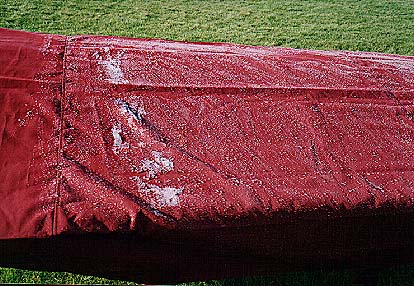
4. Do our covers protect from ice and rain? See for yourself!
As you can see, these covers have kept all the rain and ice off the aircraft, saving you a few hours defrosting your aircraft and maybe scratching your paintwork into the bargain! But with fitted covers you spend minitues taking the covers off - no damage is done and you can go flying!
4. Should I have my aircraft cleaned before fitting the cover for the first time?
Definitely! The company we recommend is Air Defence - www.airdefence.co.uk
They are experts in all aspects of paint and perspex care and rejuvination. What more can we say!
5. What about Aerial Measurements?
Go here Measuring Instructions for printable measuring instructions. Basically, each aerial or protrusion is measured off forward or aft of a datum point - namely the Top Edge of the Windscreen (TEW/s) We will need to know what the protrusion is - if you are not sure what they are you can find pictures and descriptions of Aerials
Q.
What area will the cover enclose?
We recommend starting the cover at
the engine cowling. This provides a secure fixing point from which to tension
the rest of the cover - an essential point in withstanding strong winds. This
also helps to prevent rodents and birds from entering the engine bay and cabin,
and prevents the formation of condensation - the engine and ignition killer!
The cover will enclose all windows, doors and baggage lockers.
Please email questions to: Information
You will receive a personal answer, and your question will be posted on this page!
Email: info@cambraicovers.com
The entire content of this site is © copyright Michael Whitley 1997 - Present